


 MONTESSORI BIOLOGY
 Kingdom Plantae
KINGDOM PLANTAE : Bryophyta

Division Bryophyta

Bryophytes are plants that usually
grow in moist habitats. Bryophytes do
not have the special tissue that moves
fluid through a plant as other plants have.

Therefore, surrounding water is
required to move nutrients to different
parts of the plant during times of growth.

The most known of the
bryophytes are the mosses.

Pinegreenwoods Montessori
Montessori Biology
KINGDOM PLANTAE : Psilophyta

Division Psilophyta

Psilophytes are plants that have
a branching systems that grows in two
directions. Psilophytes have very small
scaly outgrowths along the branches.

At the axis of the scales there is
a three-part , yellow-brown,
bud-like growth. The psilophytes
have a close relationship to a
fungus in the Zygomycota Phylum.

The most known of the
psilophytes is the whisk broom.
Pinegreenwoods Montessori
Montessori Biology



.JPG)


KINGDOM PLANTAE : Lycopodophyta
Division Lycopodophyta
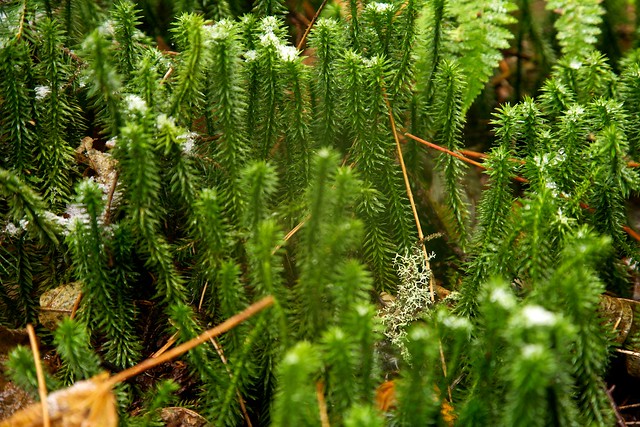
Lycopodophytes are plants that
do not bear seeds. Sporangia are
organs that produce spores which
the lycopodophytes reproduce.
Sporangia are small leaves that are
tightly arranged on the branches. Some
of the small leaves are modified into the
sporophyll leaves and the aporangia.
These modified leaves produce
the spores. The most known of the
lycopodophytes is the club mosses.
Pinegreenwoods Montessori
Montessori Biology
KINGDOM PLANTAE : Sphenophyta
Division Sphenophyta
Sphenophytes have photosynthetic stems.
These stems are hollow and jointed.
Sphenophytes have rough and ribbed stems.
Sphenophytes live along freshwater
banks, saltwater flats, and marshes.
At the end of the stem is a cone-like
structure called the strobilus. The strobilus
is made of modified leaves that form
sporangiophores and sporangium
for reproduction by means of spores.
The most known of the
sphenophytes is the horsetail.
Pinegreenwoods Montessori
Montessori Biology
KINGDOM PLANTAE : Filicinophyta
Division Filicinophyta
Filicinophytes are commonly called ferns.
Ferns live in moist areas which require water
at least during fertilization. Filicinophytes
reproduce by means and spores.
Filicinophytes have large green leaves.
They develop compound leaves called
fronds which form branches off the main
stem. Sporangia can grow on the
underside of the front leaflets.
They cluster into group called sori.
The source is covered with a special
tissue called indusia. Indusia dries
up thereby freeing the spores.
Pinegreenwoods Montessori
Montessori Biology
KINGDOM PLANTAE : Cycadophyta
Division Cycadophyta
Cycadophytes are often palm-like with
compound leaves. The cycadophytes
have scaly trunks, because as leaves shed
the base of the leaf remains on the trunk.
Photosynthesis occurs in the leaves at the
top of the plant. Cycadophytes bear seeds
not enclosed in an ovary. Cycadophytes
usually have unbranched leaves.
Cycads have a deep, extensive root system,
and arial roots house cyanobacteria, which
serve as nitrogen-fixes for cycads. Strobili
develop for embryo and pollen production.
Pinegreenwoods Montessori
Montessori Biology
KINGDOM PLANTAE : Ginkgophyta
Division Ginkgophyta
Ginkgophyta bear a characteristic
fan-shaped leaf. The leaves grow off the
branches producing a small strobili.
The strobili develop just beneath the
ginkgo leaves in the male ginkgo.
In the female ginkgo, ovules develop
beneath the leaves.The pollen from the
male ginkgo fertilizes the ovules of
the female ginkgo. The strobili develop
just beneath the ginkgo leaves
in the male ginkgo.
in the male ginkgo.
Pinegreenwoods Montessori
Montessori Biology
KINGDOM PLANTAE : Coniferophyta
Division Coniferophyta
Coniferophyta are cone-bearing trees
or something scrubs. Conifers have leaves
that are needle - like.The stems contain a
sticky resin liquid. The cones of the conifer
are both male and female on the same tree.
The actual fertilization may take a year.
When the pollen and the eye meet an
embryo is formed. The embryo is not
covered by the ovary wall. Conifers
are known as pine trees.
Pinegreenwoods Montessori
Montessori Biology
KINGDOM PLANTAE : Gnetophyta
Division Gnetophyta
Gnetophyta are cone-bearing,
low - lying plants.The cones, unlike
coniferophyta, do not have sticky resin.
These are male and female cones
on the same plant. The seeds
have stored food cotyledon.
The seeds are not covered by a testa
which is the protective coat that the
seeds on angiospermophyta have.
Pinegreenwoods Montessori
Montessori Biology
KINGDOM PLANTAE : Angiospermophyta
Division Angiospermophyta
Angiospermophyta are the most
familiar plants. The angiospermophyta
are flowering plants. The flower is
the reproductive organ.
Contained in the flower is the male part
(stamen) and the female part (pistil).
The seed that is produced by the
angiospermophyta has stored food
(cotyledon) and a seed coat (testa)
around the embryo.
Pinegreenwoods Montessori
Montessori Biology


